
The 2026 edition of “ZeroedIn: The Brand Marketing Pulse” is now live.
The UK government has just marked its own homework on its core corporate carbon disclosure rule. The result? Streamlined Energy and Carbon Reporting (SECR) works! It has delivered an estimated £5.1bn of net social value, and pretty impressive cuts in energy use.
The review also recommends amendments, and signals a 2026 consultation that could finally pull SECR, ESOS, IFRS-based standards and the UK’s new Sustainability Reporting Standards (UK SRS) into closer alignment.
If your organisation reports under SECR, or is heading that way, the message from the Department for Energy Security and Net Zero (DESNZ) is clear: the data baseline you build now is the one you will be judged against when the rules tighten. Here’s what the review actually found, and what it means for how you measure.
DESNZ’s 2026 Post-Implementation Review, underpinned by an independent evaluation from ICF Consulting Services and IFF Research, is unusually positive for a piece of regulation under scrutiny.
The numbers worth knowing:
SECR behavioural theory of change.
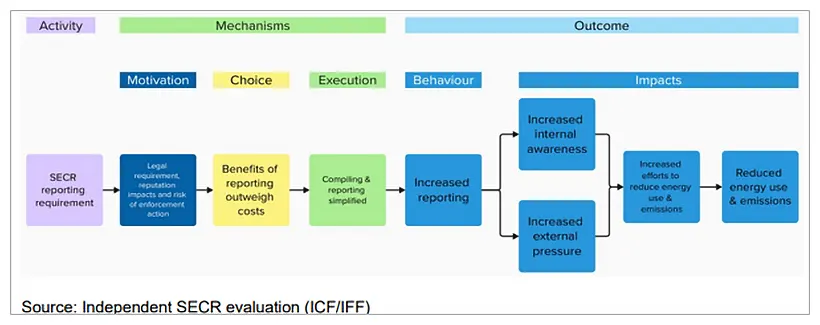
Our opinion – the Schrödinger’s Cat of Carbon: Requiring companies to measure and publish their energy and carbon performance changed behaviour. Was this simply the observer effect, the act of counting moving the number? Partly.
But from our experience working with clients, although the act of measuring matters, so does being able to see the figures so easily, every year. And with energy costs soaring, that visibility has handed companies leverage to cut both costs and carbon. The key is that the results are audited. CFOs and auditors, alongside board members and other stakeholders, end up reading energy and carbon numbers they would never otherwise have seen, and naturally they read them through a cost lens, spotting opportunities to improve the financial bottom line.

We think one of the most interesting numbers in the review, apart from how much carbon SECR saved, is how that carbon is valued. When the government appraises whether a policy is worth its cost, it puts a monetary figure on every tonne of CO₂e avoided. This is the social value of carbon (often just called the carbon value): an estimate of the damage to society avoided by not emitting that tonne. It is an appraisal figure used in cost-benefit analysis, not a tax or a market trading price.
Where does it come from? It’s set out in supplementary guidance to HM Treasury’s Green Book, the government’s guidance on appraisal: the process of assessing the costs, benefits and risks of different options for achieving government objectives. The review compares the figures used when SECR was designed against current guidance, and the shift is dramatic.
When SECR’s original Impact Assessment was written, the UK split emissions into two categories. ‘Traded’ emissions, those already covered by a carbon market such as the EU or UK Emissions Trading Scheme, were valued at roughly £6 per tonne of CO₂e in 2020. ‘Non-traded’ emissions were valued at about £87 per tonne (both in 2025 prices). Current guidance has scrapped that split entirely and values all emissions at a single social value of carbon, with a central figure of £282 per tonne of CO₂e for 2020 (2025 prices).
From £6 (traded) and £87 (non-traded) in 2020 to a single £282 per tonne of CO₂e. The official appraisal value of carbon abatement has more than tripled against the old price
Why does this matter beyond the accountants’ spreadsheets? Because revaluing the same tonnes of avoided carbon at the higher figure is a major reason SECR’s monetised carbon benefits came in at £3.2bn against an original prediction of just £0.2bn, a sixteen-fold increase.
The carbon we cut today is officially worth far more than it was when SECR was designed, and the direction of travel is still upwards. For any UK organisation, whether in scope for SECR or not, that reframes carbon reduction: every tonne we can credibly measure and remove is an asset whose recognised value is climbing. Accurate measurement is what lets us claim it.
The most striking statistic in the review is about disclosure that simply would not have happened otherwise:
79% of compliant businesses said SECR put energy and carbon data into the public domain that they would not otherwise have published.
That’s the gap between intention and action shrinking. And it didn’t just stay in the sustainability team:
Investors and lenders told the evaluation they value SECR data because it’s standardised and sits inside statutory filings, making it easy to extract and easy to compare. It’s easy to find – just search for any in-scope business on Companies House website, and look for the SECR statement in the latest set of accounts.
The review’s highlights that backward-looking disclosure is foundational. Targets, transition plans and forward-looking frameworks all depend on credible, consistent underlying data against which to measure progress.
We’ve seen clients record all of their SECR figures side by side every year since they began reporting, despite only needing to publish the latest two years’ worth in their annual strategic reports. This is because it provides such an easy and accessible tracker, that lets you quickly grasp progress since year one, and year-on-year percentage changes at a glance.
Here is where the review becomes interesting for anyone choosing how to resource their reporting.
Compliance cost businesses far more than the original Impact Assessment assumed:
When two-thirds of your compliance budget is going to external consultancy support, having SECR reports drop out of your climate transition SaaS platform drastically reduces costs, as well as administrative effort.
Tucked into the review is a warning that should shape how you build your carbon inventory from the start. SECR’s scope is deliberately narrow for unquoted companies and LLPs: UK operations only, limited Scope 1, only location-based Scope 2, and only selected Scope 3 categories (partial business travel the only mandatory category).
The risk DESNZ flags directly:
Organisations that start their carbon journey with a partial, UK-only baseline can find that emissions appear to “increase” later, simply because they have added the categories and geographies that were missing all along. That creates reputational exposure and stakeholder confusion that has nothing to do with actual performance.
We have clients who have to report the full scopes footprint for those subsidiaries qualifying for Climate-Related Financial Disclosures, and each year there’s confusion amongst auditors when comparing that with the partial footprints in their SECR reports.
This is avoidable. A complete baseline (full Scope 1, location- and market-based Scope 2, and a genuine Scope 3 footprint across all 15 categories) costs little more to build correctly the first time and protects you from the awkward communications when scope expands (as it inevitably will).
At 51toCarbonZero, our platform draws on 40,000+ emission factors and 3,000+ pre-built integrations to build that complete picture from the outset, typically cutting measurement time by around 40%, so the baseline is right before the rules force the question.
Percentage of organisations that find it easy to reuse SECR data for other initiatives, or vice versa.
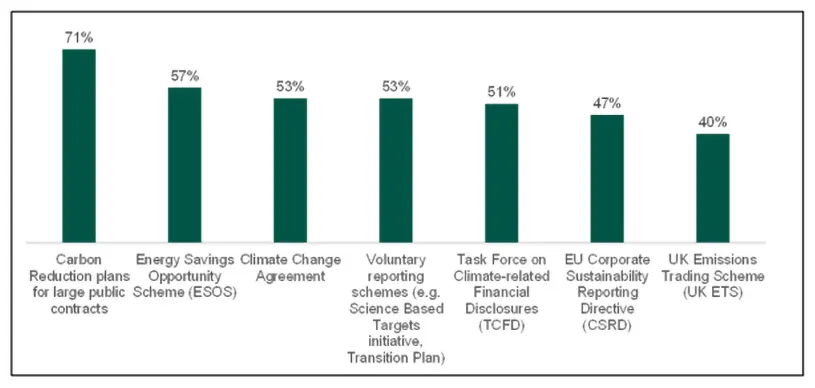
The review’s formal recommendation is ‘Amend’: retain SECR, but reform it. The mechanism is a planned 2026 consultation on streamlining energy and emissions reporting, and the direction of travel is unambiguous, even if the specific decisions are not yet made. On the table:
My big caveat: these are proposals for consultation, not yet in law. DESNZ is explicit that they ‘do not represent final decisions’. But synchronising frameworks makes so much sense it’s unlikely the convergence won’t continue. The end state the government is steering towards is a reporting landscape where just one UK climate framework exists, that’s interopable with ISSB’s IFRS S1 and S2. The clue’s in the name – ‘Streamlined energy and carbon reporting’ – perhaps we can have streamlined reporting across all frameworks, cutting out the administrative burden and freeing us up to actually cut emissions!
The organisations that benefit most from that convergence will be those whose underlying data is already clean, complete and structured to flex across frameworks. The ones who will struggle are those treating each regime as a separate, last-minute scramble. Having said that, with our platform, we manage to lift the stress off latecomers and haven’t missed a deadline yet!
The review confirms that measurement is not just a compliance chore. When we use it to provide leverage, it can improve our financial bottom line. Get the carbon and energy data right once, structure it properly, and it carries you across SECR today, UK SRS and ISSB-aligned disclosure tomorrow, and your own net-zero targets throughout.
The problem the wider market still faces is stark: 80% of listed companies have a net-zero ambition, but only 11% have achieved any actual carbon reduction.
51toCarbonZero pairs proprietary software with hands-on expert advisory through our Climate Unlimited™ model: a named Climate Success Manager, no hourly billing, and expert input applied directly to your platform data. With AI-aided multi-format data ingestion, we take the pain out of carbon reporting, and actually use it to transition to net-zero.
info@51tocarbonzero.com | 020 4578 4040 | www.51tocarbonzero.com
Sustainability Made Simple.
Source: Department for Energy Security and Net Zero (2026), Post-Implementation Review of the Companies (Directors’ Report) and Limited Liability Partnerships (Energy and Carbon Report) Regulations 2018 (the SECR framework), and the independent SECR evaluation by ICF Consulting Services Ltd and IFF Research. Carbon valuation figures are drawn from supplementary guidance to the HM Treasury Green Book on the valuation of energy use and greenhouse gas emissions for appraisal.