
The 2026 edition of “ZeroedIn: The Brand Marketing Pulse” is now live.
Asia Climate Bulletin Series | 51toCarbonZero | April 2026
The narrative that corporate climate action is stalling suits a particular political moment. It does not suit the data – certainly not all of it anyway.
The SBTi’s newly-published 2025 Trend Tracker tells a story that’s pretty-much the opposite of retreat – and nowhere more strikingly than across Asia. While some Western governments revise their ambitions downward, Asia’s corporate sector is accelerating in a way that will reshape supply chains, investor expectations, and competitive dynamics.
This bulletin focuses on what the numbers show, what’s driving them, and what they mean for any organisation with operations, suppliers, or customers in the region.
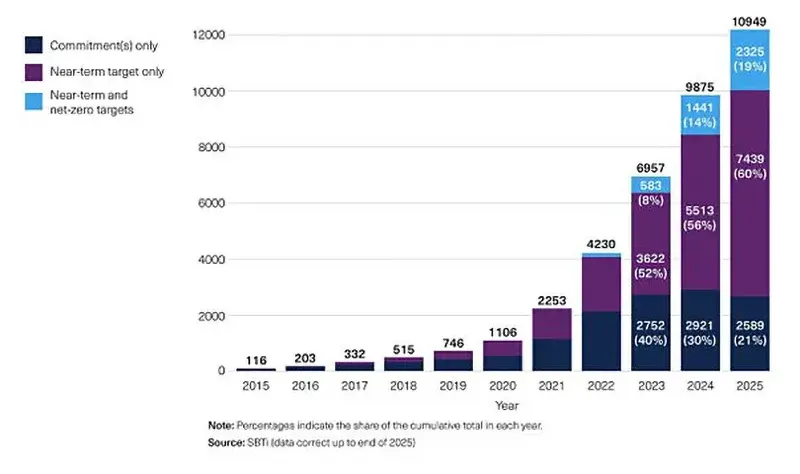
By the end of 2025, Asia saw the highest proportional growth in companies setting validated science-based targets of any global region – up 53%, from 2,297 to 3,513 companies. To put that in context: Africa grew by 48% and Latin America and the Caribbean by 42% – both impressive – but Asia’s growth wasn’t just the fastest proportionally, it was by far the largest in absolute terms.
Overall, Europe (4,769) still leads as the region with the highest number of companies with validated targets, followed by Asia (3,513) and then North America (1,076). Asia has firmly cemented second place globally, and it looks like closing the gap with Europe soon.
This is the story beneath the geopolitical noise. The companies setting science-based targets in Asia haven’t been mandated by a regulator. They’re doing it because the real impacts of climate change felt in the region are making the commercial and competitive logic increasingly compelling – and because the investors, customers, and supply chain partners demanding it have a growing presence in the region.
The SBTi data reveal patterns across high- and low-penetration Asian markets that are worth understanding for companies trading in the region.
Japan continues to lead in the total number of companies with validated targets, at 60% of all Asian companies. As a wealthier Asian country, Japan has been an early mover, reflecting both strong domestic governance culture and significant pressure from its institutional investors.
But it is China’s trajectory that makes one sit up and take note. China recorded a 92% increase among high-penetration markets, from 312 to 598 companies – the fastest percentage growth rate of any established market globally, not just in Asia. It’s a small number as a proportion of the total number of companies, but the direction of travel is what’s interesting.
For a country often seen as a manufacturing emissions source as opposed to a climate action leader, this could be a significant shift. It reflects growing pressure from multinational supply chain partners, evolving domestic regulation, and the ambitions of Chinese companies increasingly competing on global markets where sustainability credentials matter. Perhaps even more importantly, China got in relatively early when it came to climate risk action. Most countries are aware of the risks to humanity from climate breakdown, but few act on it with anything like the ambition and speed needed. Reducing emissions shows an understanding of transition risk, from energy insecurity and lack of control over costs, all the way up to stranded assets, and although China’s electricity fuel mix is still dominated by coal at around 60%, it has recently pivoted to contributing to over half of the global increase in solar and wind generation.
In India the number of companies with SBTs grew by 40%, and in Taiwan by 53%. Both are significant manufacturing and technology hubs where supply chain pressure from global brands and the extreme local effects of global heating are key drivers.
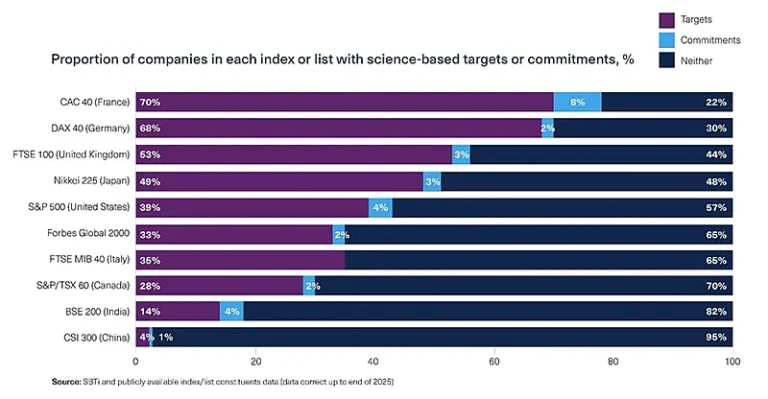
Among lower-penetration markets – those with between 10 and 99 companies with targets at the start of 2025 – the Asian results are all relatively significant.
Indonesia doubled its number of companies with validated targets to 22, Pakistan grew by 92% to 25, Singapore by 59% to 51, Thailand by 47% to 28, and South Korea by 43% to 70.
These are not marginal markets. Indonesia is the world’s fourth most populous country and a significant manufacturing base. Singapore is a major financial hub whose institutional investors increasingly apply ESG screens. South Korea is home to some of the world’s largest conglomerates. The expansion of science-based target adoption into these markets signals that the shift is structural, not confined to a handful of first-mover economies.
The sectoral breakdown within Asia’s three highest-emitting territories – China, Japan, and India – reveals where the momentum is concentrated, and where it is likely to head next.
In China, Information Technology saw 145% growth, Consumer Staples grew by 100% and Consumer Discretionary by 87%. The technology sector’s rapid adoption is particularly significant: these are companies with global supply chains, international investors, and a growing dependence on energy, water and high-risk minerals and elements.
In Japan, Materials saw the largest proportional growth at 68% followed by Health Care at 62% and Energy & Utilities at 48%. In Japan, Materials is a foundational industrial sector, and its movement toward science-based targets has significant upstream and downstream implications for supply chains across the region.
In India, Health Care was the fastest growing sector at 108%, followed by Consumer Discretionary at 45% and Information Technology at 37%.
Much of the growth in Asia is market-driven. The mechanism is straightforward: multinational brands sourcing from Asian manufacturers and suppliers have embedded science-based target requirements – or at minimum, emissions disclosure requirements – into their procurement standards. A Tier 1 supplier to a European automotive group, a Japanese electronics manufacturer selling to US tech companies, an Indonesian vegetable oil producer seeking access to European markets: each faces direct commercial pressure to demonstrate credible climate credentials. That pressure flows down supply chains with remarkable speed.
Investor pressure is the second engine. Asian institutional investors – particularly in Japan, Singapore, and increasingly South Korea – have materially increased their ESG screening and engagement activity. Japanese Government Pension Investment Fund (GPIF), the world’s largest pension fund, is a case in point: its proxy voting and engagement practices have pushed listed Japanese companies toward disclosure and target-setting in ways that now show up in the SBTi data.
The third driver is competitiveness in capital markets. Companies in Asia seeking listings, partnerships, or financing in European and US markets face increasing scrutiny of their climate credentials. Science-based targets have become a threshold requirement in many of these contexts, not a differentiator.
None of these drivers disappears because of a downplay of environmental action elsewhere in the world.
The 53% growth in Asian corporate science-based targets in a single year is a signal:
If you buy from Asia, your suppliers are increasingly operating in an environment where climate credentials are a commercial expectation. The companies ahead of that curve will be easier, lower-risk partners. Those behind it are accumulating Scope 3 exposure in their value chains.
If you sell in Asia, the baseline expectations of sophisticated buyers, investors, and partners are rising. A validated science-based target is no longer a leading-edge commitment in Tokyo, Shanghai, or Singapore. It is becoming table stakes.
If you operate in Asia, the direction of travel is toward a realistic transition plan to a zero carbon future, both to pre-empt corporate legislation and to shore up your own climate risk.
If your operations are elsewhere in the World, the data also matters for how we understand the global picture. The rapid growth in Asia signals that corporate climate ambition is expanding beyond Europe, with the frontier of climate action increasingly shifting toward Asia and emerging markets. For any organisation thinking about where the next decade of supply chain, investment, and commercial relationships will be forged, we meed to factor this into our business plans.
This is a start, but nowhere near enough, let’s face it. 3,513 companies with validated targets across a continent of billions – with thousands of large corporations, tens of thousands of mid-market businesses, and intricate global supply chains – is just the beginning.
Across all sectors and territories, 80% of listed companies claim a net-zero ambition.
Only 11% have achieved any actual carbon reductions.
The gap between intent and measurable action remains vast. The momentum shown in the SBTi data is encouraging. Closing the gap is our work.
At 51toCarbonZero, we work with organisations across sectors and geographies – with a focus on Asia – to move from ambition to verified progress. Whether you’re beginning to measure your footprint and set science-based targets, building supply chain engagement and transitioning to the low carbon economy, or addressing physical climate risk, the time to act is not when the politics and economics settle. The time is now.
Because the companies setting targets in Asia today are building the competitive advantage that will matter in the decade ahead.
This article is part of the 51toCarbonZero Asia Bulletin series, tracking corporate climate action across the Asia-Pacific region.
Data drawn from the SBTi Trend Tracker 2025, published April 2026.