
The 2026 edition of “ZeroedIn: The Brand Marketing Pulse” is now live.
The Science Based Targets initiative published Version 2.0 of its Corporate Net-Zero Standard on 11 June 2026, the biggest revision since the standard first appeared in 2021, and it changes how targets are set, how progress is evaluated, and what part market instruments can play. Here’s what this means for your company’s targets.
The new standard restructures corporate target setting around continuous five-year cycles. Companies are categorised as either type A or B, segmented by size, income level, geography and emissions. Near-term targets for scopes 1 and 2 are mandatory for everyone and must now be set separately, each covering 100% of the scope; scope 3 targets are mandatory for Category A and cover every scope 3 category making up 5% or more of scope 3 emissions. Long-term and net-zero targets remain optional for nearly all companies.
The emphasis has shifted to include delivering against the targets, incorporating transition plans and the use of market instruments to demonstrate decarbonisation.
Five significant target delivery changes:
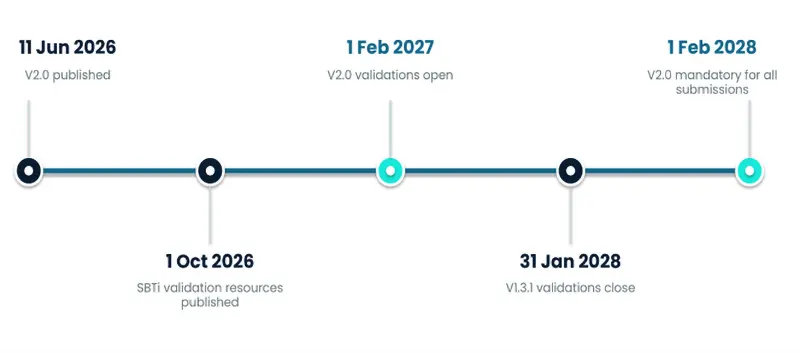
Which version applies is set by the date the SBTi receives a submission. What that means in practice depends on where a company is starting from. Version 1 remains open to submissions until 31 January 2028. Version 2 validations open on 1 February 2027, so between those dates every company has a choice of version. From 1 February 2028, V2.0 is the only route.
Companies with validated targets
Existing targets remain valid, and the next submission is driven by whichever comes first:
Companies with an active commitment
The commitment deadline determines which version you apply.
If your commitment deadline is:
Companies with deadlines before 1 February 2027 that want to wait for V2.0 can request an extension from SBTi Services, after which the public dashboard shows the status as ‘Extended’ with the reason ‘Adoption of CNZS V2’.
Companies not yet committed or validated
Until 31 January 2027, the existing commitment types remain available. From 1 February 2027 there is a single ‘SBTi Commitment’, fulfilled under V2.0 only. Anyone starting now should read the differences between the standards below, and weigh carefully which version is best suited to their business needs, and whether building V2.0-ready from the outset will smooth their revalidation processes going forwards..
Scope 1
Direct emissions carry a near-term five year target for every company, covering 100% of the scope and set separately from scope 2.
Three methods are available:
The last two come with additional obligations: any company choosing the intensity or asset-transition route must also set a long-term scope 1 target. That obligation applies to every company, whether Category A or Category B..
Scope 2
Scope 2 sees a major change in accounting methodology. Target ambition is set on the physical inventory, using the location-based method only. Market-based emissions accounting as a way to demonstrate renewable energy uptake is not included in V2.0. Instead, market instruments are recorded separately to evidence reductions.
Companies choose between two target types.
Emissions from heat, steam and cooling use the absolute method.
Category A companies projecting electricity demand growth above 20% over the cycle must set the absolute emissions target rather than rely on LCE share alone.
Scope 3
The biggest change is in how you set and deliver scope 3 targets.
Threshold: The threshold test for requiring a Scope 3 target (40% or more of total emissions) has been discontinued.
Boundary: The near-term target boundary has changed from at least 67% of scope 3, with the company choosing which categories counted, to mandatory Scope 3 targets covering every category at or above 5% of scope 3 emissions.
Exclusions: Named, justified exclusions of Scope 3 categories must be reported and quantified.
Delivery: EACs can be used with category and activity targets, to demonstrate alignment in procurement decisions with a net-zero pathway.
Three target routes are available:
These count as interim delivery measures under strict guardrails: the certificate must correspond to activity within twelve months, move through secure registries, and avoid double counting. Where emissions reductions are not reflected in the physical inventory they are reported separately, as a contribution to decarbonising the wider system rather than a cut to the company’s own emissions.
Validation: A company registers, is categorised, and sets its base year, which must now be the most recent year with comprehensive data. Its target year is 5 years from the base year.
Progress report: Within each five-year cycle, companies report progress publicly every year as they did under Version 1.
Spot audits: The SBTi may carry out spot checks and focus checks mid-cycle, the former random, the latter prompted by something specific.
End of cycle assessment: At the end of the cycle comes an end-of-cycle assessment, completed no later than twelve months after the target timeframe ends and independently assured for Category A.
Next validation: The next target validation lands no earlier than 24 months before and no later than 12 months after the timeframe ends, and the cycle begins again with a fresh base year.
Governance and transition: Governance underpins all company decisions: targets require approval at the highest governance level, every company must develop and maintain a transition plan, and Category A companies must disclose theirs within fifteen months of validation and obtain third-party assurance of their base-year inventory.
Environmental attribute certificates is the collective term for certificates proving low carbon products.
Scope 2: No certificate can reduce the reported emissions figure, because the inventory is location-based and instruments not reflected in the physical inventory are accounted for and reported separately. But an LCE alignment target is met through electricity used, contracted or matched, and the eligible instruments include power purchase agreements (PPA), supplier contracts and unbundled energy attribute certificates. A company can therefore meet its scope 2 target through procurement, while its physical emissions figure is calculated using the average grid carbon intensity.
Scope 3: The big shift is in allowing the use of EACs against Scope 3 targets. The implementation hierarchy requires direct, activity-level action first. Where direct routes are proven to be structurally blocked, action at the activity-pool or sector level counts as an interim measure, and that explicitly includes purchasing energy attribute certificates and commodity certificates.
Guardrails apply: instruments must conservatively represent the underlying activity, align temporally within twelve months of the emissions they address, and move through secure registries that prevent double counting, with Category A companies obtaining assurance for their progress data.
The standard calls these ‘interim measures’ but hasn’t published a sunset date. Our advice is to treat certificates as a bridge, not the ongoing strategy, because purchased attributes are not reductions.
Definition: This is defined as a level of effort demonstrated through implementing all actions within a company’s control or influence that are necessary and appropriate to implement its targets, including identifying, reporting and actively managing material dependencies and risks.
Implementation hierarchy: Companies must apply the implementation hierarchy: direct action at the activity level first, then activity-pool actions, then sector-level actions, each tier permissible only where the one above is proven to be genuinely constrained.
Meeting targets: Missing a target is no longer a pass-or-fail event: a company that falls short while demonstrating effort and managing its barriers stays in the framework, and its next cycle simply starts from its actual emissions, so falling short now means cutting faster in the future.
This is a softer test than Version 1’s assessment of whether targets are met. The minimum progress criteria under ‘best efforts’ have been deferred to the forthcoming SBTi Assurance Manual and will not apply until companies revalidate after their first V2.0 cycle. Until then, effort and transparency set a company’s standing, rather than outcome alone, which means a lot depends on the quality and honesty of annual reporting.
Retrofit to Version 1: The best-efforts principle applies to V1 targets during the transition, so this is not a reason on its own to choose one version over the other during the choice window.
Categorisation defines scopes and boundaries.
Who is Category A, and who is Category B?
Category A
Any company that meets either test:
Category B
How the test is applied
Ongoing Emissions Responsibility: Beyond the value chain sits Ongoing Emissions Responsibility, a voluntary recognition programme for companies taking responsibility for the emissions they are still producing, through verified mitigation outcomes or climate contributions priced at a minimum of USD 20 per tonne for the Engaged and Advanced tiers and USD 80 for Leadership. It is held outside targets, framed as a complement and never a substitute. From 2035, under a requirement the standard itself labels illustrative, Category A companies must support eligible carbon removals, starting at 1% of ongoing emissions and rising linearly to 100% by the net-zero year.
Sector-specific Standards: Sector standards are used together with V2.0, but do not replace it. Every company uses the Corporate Net-Zero Standard as its foundation and sets its cross-sector near-term targets under it, at the same time as checking whether any SBTi sector standard, including the Financial Institutions Net-Zero Standard, also applies. Sector standards specify emissions sources covered, and the company follows its criteria for those rather than setting a duplicate Corporate Net-Zero Standard target for the same emissions. The two run in parallel rather than one displacing the other: a company with land-based emissions, for instance, sets FLAG targets and its non-FLAG targets separately, never merged into one.
Note that the SBTi is still updating its sector standards for compatibility with V2.0, so companies continue to use the existing versions in the meantime.
The window between February 2027 and January 2028 is a genuine decision point, and the right answer depends on your trigger dates, your data readiness and what your stakeholders expect. Through Climate Unlimited™, your dedicated Climate Success Manager confirms your category, maps your five-year review trigger and eligible version, and considers each aspect of both versions against your company’s requirements, current targets if you have them, and available resources. We hold a 100% SBTi success rate across our clients, and we will keep the focus where it belongs: genuine reductions first, instruments as a bridge.
Talk to us at info@51tocarbonzero.com or on 020 4578 4040. 51toCarbonZero. Net Zero, made simple.
Sources: SBTi Corporate Net-Zero Standard V2.0 (11 June 2026); SBTi Corporate Net-Zero Standard V2.0 Executive Summary; SBTi Services, Guide for Companies in the Transition to Corporate Net-Zero Standard Version 2.0 (June 2026).